Variable Zoo · The Zoo · Cataclysmic variables
UG · dwarf novaeA white dwarf devouring its neighbour — a binary star that flares into outburst every few weeks and flickers on the timescale of minutes.
The animal
A cataclysmic variable is a close binary star: a dense, Earth-sized white dwarf pulling a steady stream of gas off a companion. In most systems that gas spirals inward through a whirling accretion disk before settling onto the white dwarf — though in the strongly magnetic ones it is funnelled straight down the field lines onto the surface instead. The two stars typically orbit in just a few hours (the symbiotic systems, which pair a white dwarf with a red giant, take years).
Cataclysmic variables come in several flavours: classical novae, whose accreted gas detonates in a one-off thermonuclear flash; steady nova-like systems; and strongly magnetic polars. This page focuses on the most common and beginner-friendly branch — the dwarf novae (VSX class UG, after the prototype U Geminorum).
Dwarf novae erupt not by nuclear fusion but by an instability in the disk itself. Every few weeks the disk suddenly brightens by several magnitudes, then fades back, over and over — changes large, fast, and never quite the same twice, which makes them among the most rewarding variable stars for a small telescope.
The outbursts are a disk-instability phenomenon. As gas piles up in the accretion disk it stays cool and dim — until its density crosses a threshold and the disk flips into a hot, highly conductive state, dumping material onto the white dwarf in a brilliant flare. When the disk drains, it cools, and the cycle resets.
Riding on top is flickering: rapid, chaotic brightness changes over minutes as blobs of gas strike the hot inner edge of the disk. The flicker is the disk's turbulence made visible — and catching it takes nothing more exotic than a steady cadence of short exposures.
How it works
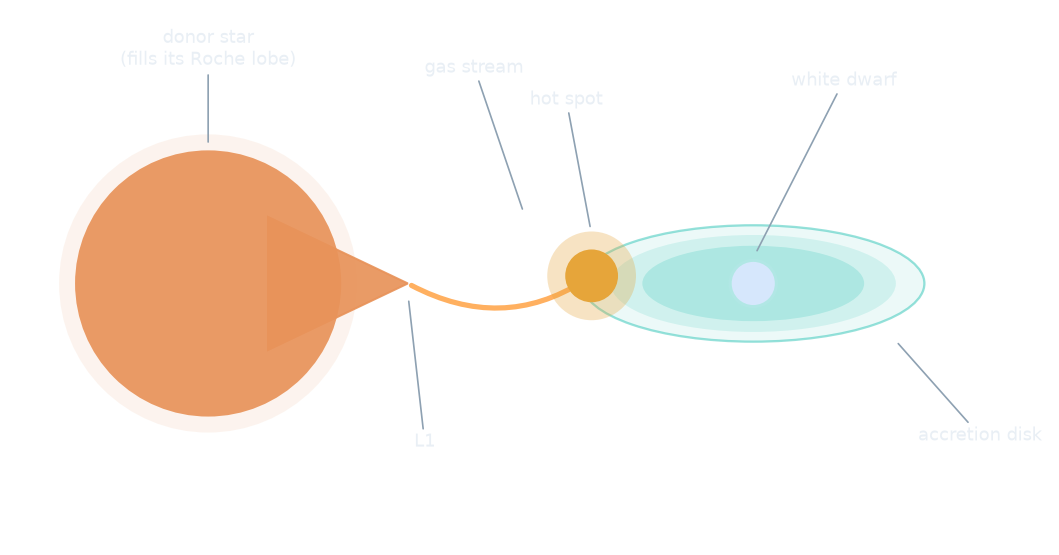
A cataclysmic variable is a tight double star. The donor has swollen until its gravity can no longer hold its outer gas, which spills through the balance point between the stars (L1) toward the white dwarf. With too much angular momentum to fall straight in, the gas settles into a whirling accretion disk; where the incoming stream slams into the disk's edge it shocks into a brilliant hot spot. Instabilities in that disk are what make dwarf novae erupt.
From our survey
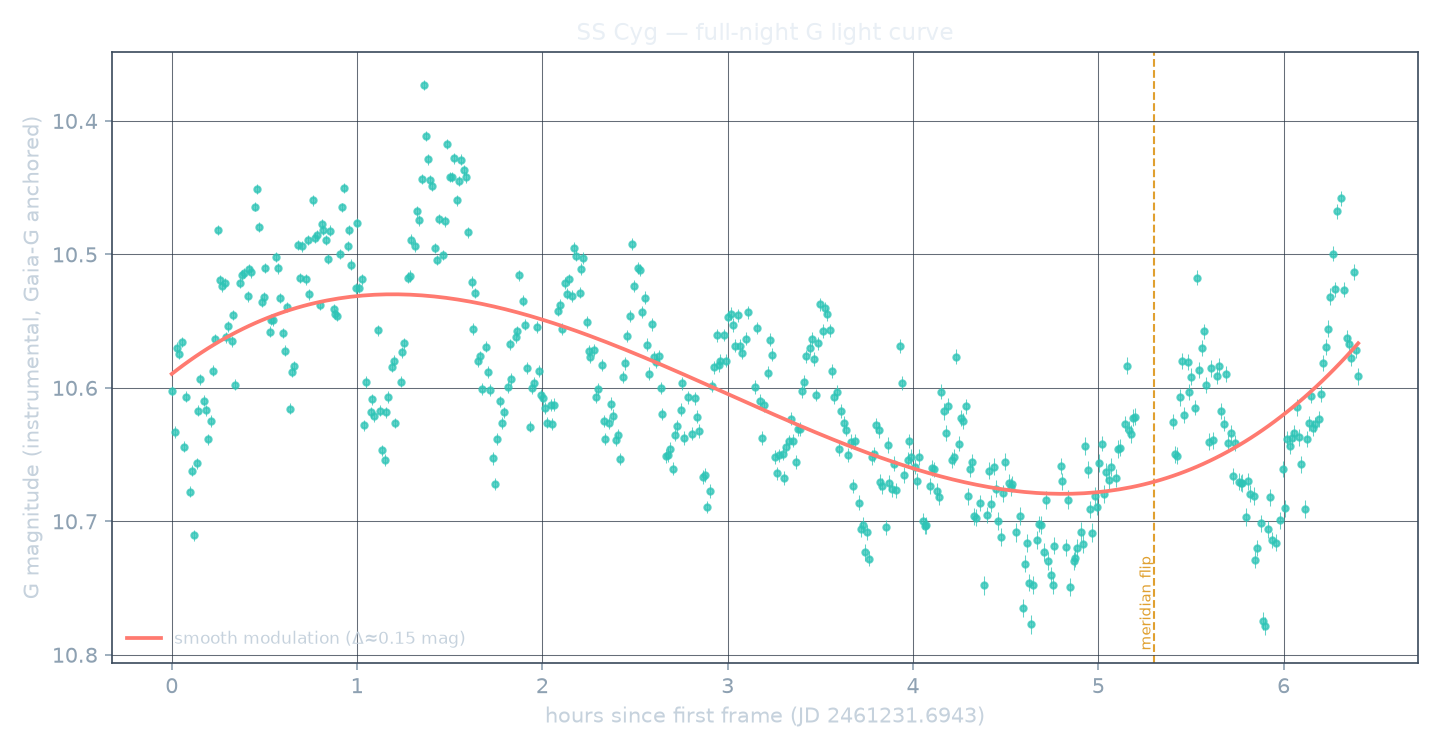
SS Cygni — one of the brightest and most-watched dwarf novae — across a single 6.4-hour night from a 60 mm refractor. Each teal point is one 30-second frame; the coral curve traces a slow ~0.17-mag modulation, and the scatter around it is the accretion disk's flicker (σ ≈ 52 mmag).
Source: The Variable Zoo Project
The bigger picture
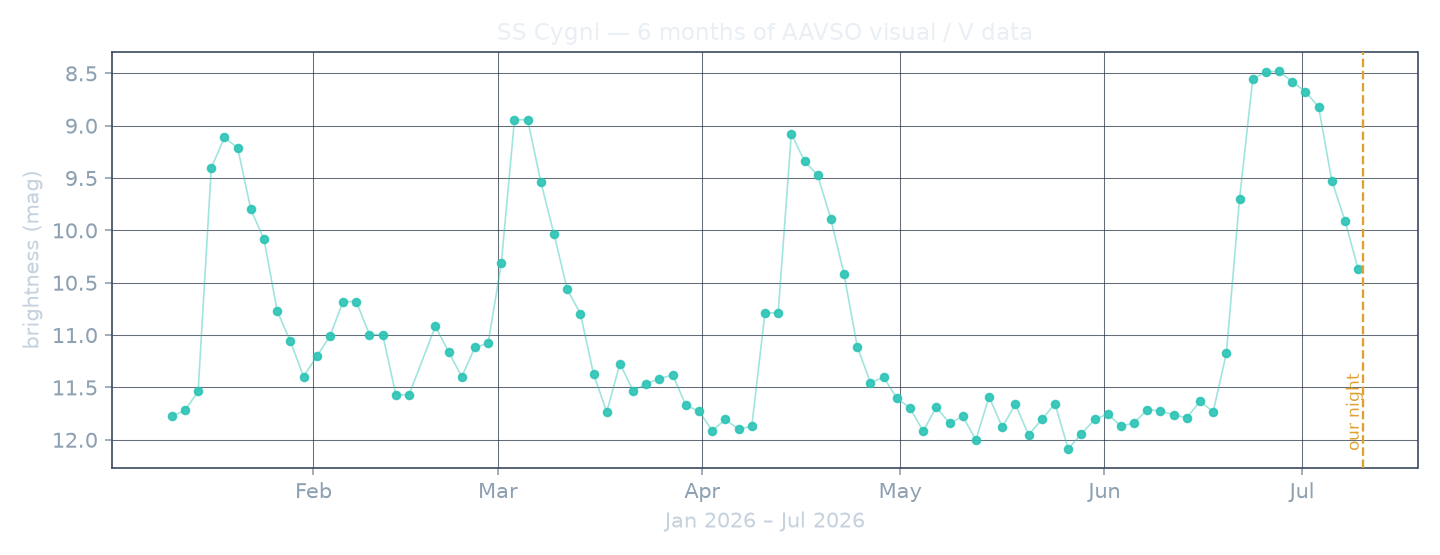
Six months of SS Cygni from the AAVSO's public database — the pooled record of thousands of observers, one nightly mean per point. The eruptions recur every 6–11 weeks, wandering cycle to cycle. Our own dense night (marked) sits at the very right edge — a reminder that as periods lengthen, a single session captures only a fragment of the whole story, and the community record supplies the rest.
Source: AAVSO
In the catalog
Out of 10.3M catalogued variables, VSX lists 21,701 cataclysmic variables. The great majority — 15,727 of them — are dwarf novae like SS Cygni; the rest are classical and recurrent novae, steady nova-like systems, symbiotic binaries, and the strongly magnetic polars and intermediate polars, all built on the same accreting-white-dwarf machinery.
Try it yourself
Dwarf novae reward two very different observing styles. To catch the sudden rise into outburst, monitor a target with one measurement per clear night and watch for the jump. To resolve the flicker and any orbital signal, run a dense single night — 30–60 second frames for several hours, exactly as in the light curve above.
A clear or green filter maximises signal, and ensemble differential photometry against nearby Gaia stars means no calibration frames are required. Bright dwarf novae like SS Cyg are within reach of a 60 mm refractor; fainter ones simply need more aperture or longer exposures.
Go deeper
A clear, well-illustrated primer on how these accreting binaries work.
The whole zoo of CV subtypes — dwarf novae, polars, novae — one step up from an encyclopedia entry.
The story and science of our showcase star, from the people who have tracked it for over a century.
A research astronomer's tour of the class, from accretion disks to outbursts.
A friendly audio explainer, good for the commute.
Observing guides, target lists, and campaigns — how to contribute your own measurements.
 Variable Zoo