Variable Zoo · The Zoo · Cepheids
DCEP · standard candlesLuminous pulsating supergiants whose period reveals their true brightness — the yardsticks Henrietta Leavitt used to measure the universe.
The animal
A classical Cepheid is a young, massive, luminous yellow supergiant passing through the instability strip. It pulsates with clockwork regularity over days to weeks, brightening and fading as it swells and shrinks.
Their fame rests on Leavitt's law: the pulsation period is tightly linked to the star's true luminosity, so measuring the period reveals the intrinsic brightness — and hence the distance. Cepheids calibrated the scale of the Milky Way and, through Hubble, the expanding universe. (Older, fainter Type II Cepheids follow their own, separate relation.)
The engine is the helium κ-mechanism: a valve of doubly-ionising helium regulates the flow of heat, driving the envelope to pulse. A larger, more luminous star has a longer natural period — which is precisely why period tracks luminosity.
The light curve rises quickly and falls more slowly, and it lags the star's size changes: a Cepheid is brightest not when it is largest, but a little after, when its surface is hottest and expanding fastest.
How it works
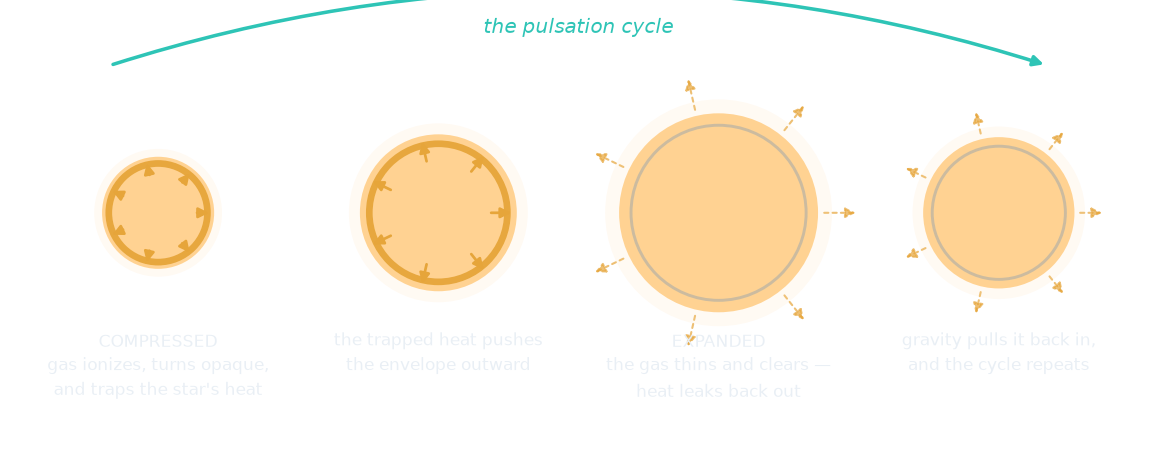
Pulsating stars are heat engines. A layer of ionizing helium deep in the envelope turns opaque when compressed — trapping heat like a closed valve — then clears as it expands and lets it out, driving the star to swell and shrink (the κ-mechanism). Crucially, a bigger, brighter Cepheid has a longer natural rhythm — which is exactly why its pulsation period reveals its luminosity.
A real light curve
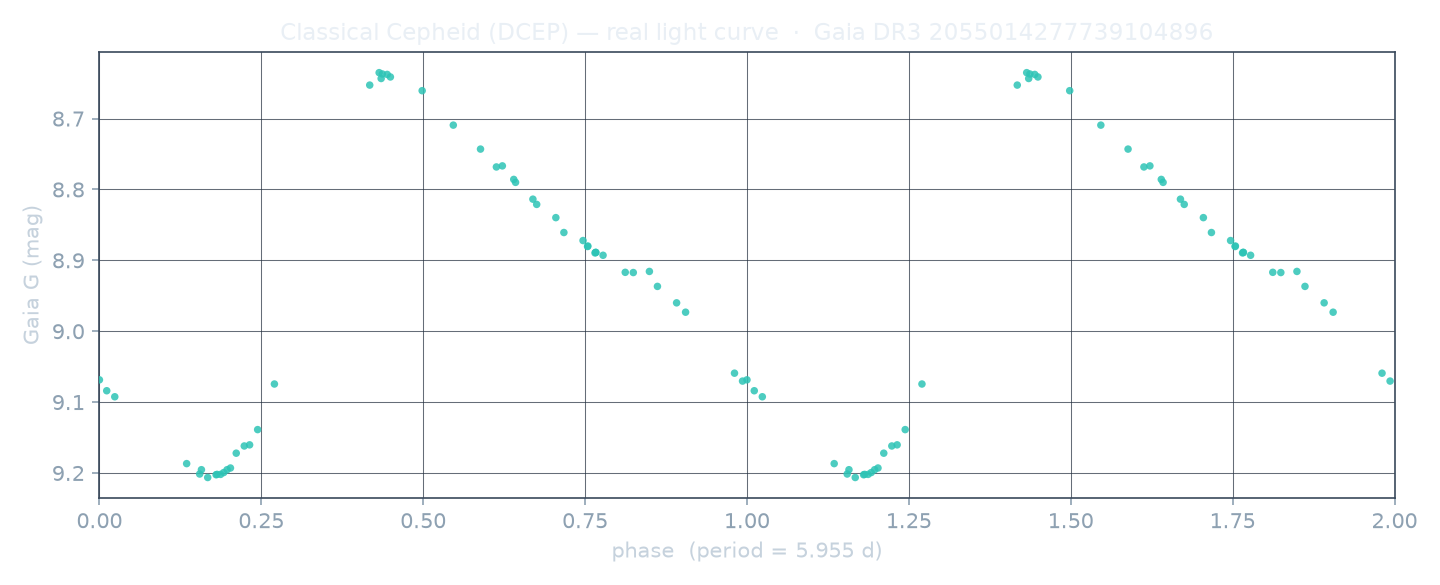
A real classical Cepheid from Gaia DR3 epoch photometry, folded on its ~6-day period. Note the asymmetry — a brisk brightening followed by a slower fade.
Source: Gaia DR3
The distance ladder
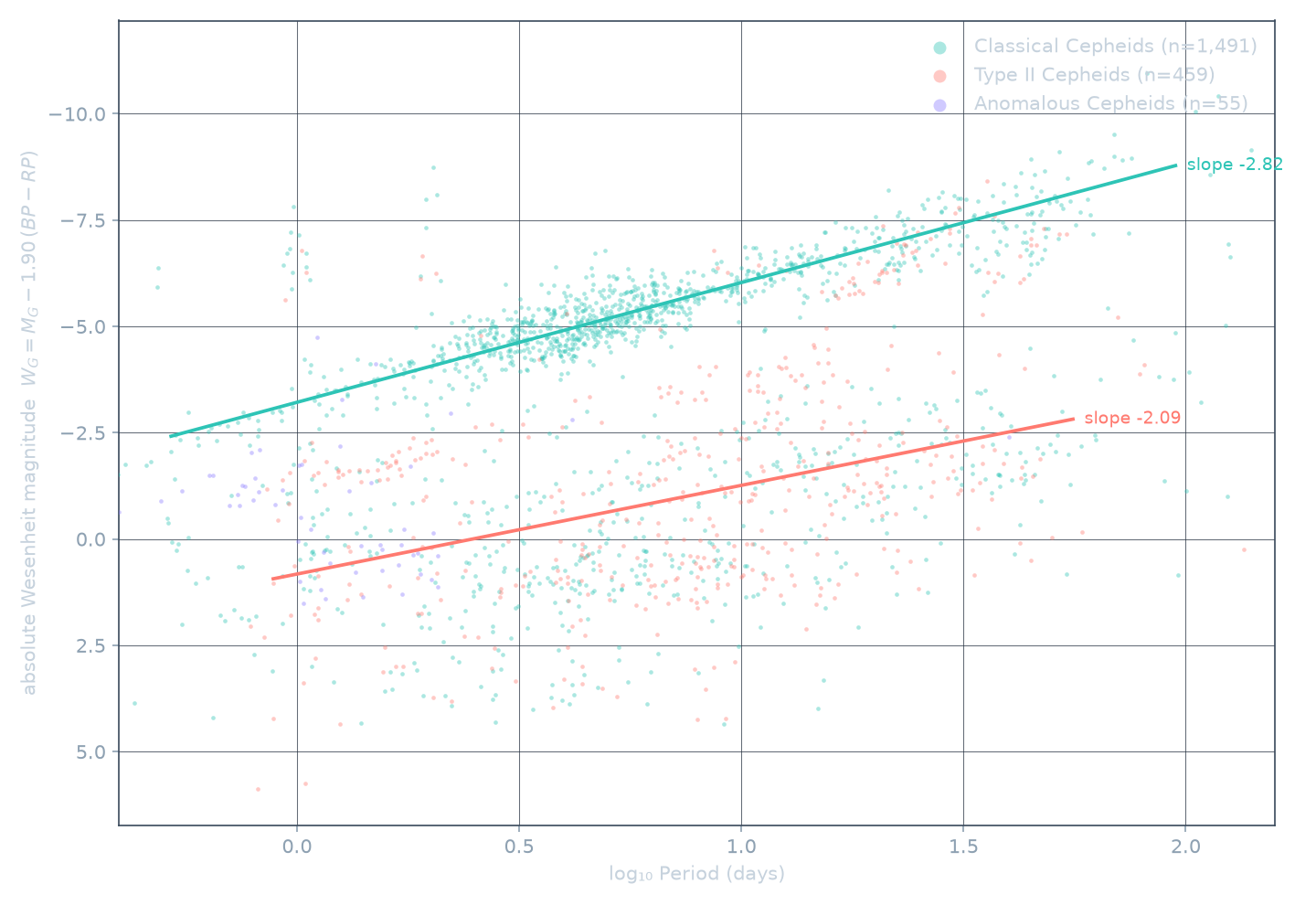
2,005 Cepheids from our own VSX × Gaia DR3 cross-match, in reddening-free Wesenheit magnitude. Longer-period stars are intrinsically brighter — that is Leavitt's law — and the classical Cepheids (teal) sit about two magnitudes brighter than the older Type II Cepheids (coral) at the same period. That very split, once mistaken for one relation, is what recalibrated the size of the universe.
In the catalog
VSX lists 18,094 Cepheids: 13,386 classical (δ Cep-type) young massive pulsators, plus a smaller population of older, fainter Type II Cepheids (2,560), which obey a different period–luminosity law.
Try it yourself
Classical Cepheids are bright and slow enough that a measurement per clear night over a couple of weeks recovers the period and its brightness signature. They are a deeply satisfying target: with your own data you can reconstruct the very relation that first let astronomers measure the cosmos.
Go deeper
An interactive, classroom-tested walk through the period–luminosity law.
The prototype star and Henrietta Leavitt's discovery.
How Cepheids and RR Lyrae anchor the whole distance scale.
