Variable Zoo · The Zoo · δ Scuti variables
DSCT · fast pulsatorsHot main-sequence stars ringing like bells — fast, subtle pulsations that last only hours.
The animal
A δ Scuti star is a main-sequence or slightly evolved star of spectral type A or F — a little hotter and more massive than the Sun — sitting at the bottom of the same instability strip as the Cepheids. It pulsates in short, low-amplitude oscillations lasting only hours.
Many pulsate in several modes at once, both radial and non-radial, layering periods into a complex beat. That makes them prime targets for asteroseismology — reading a star's hidden interior from the frequencies of its oscillations, much as a seismologist reads the Earth.
Like their larger cousins, δ Scuti stars run on the κ-mechanism in a helium ionisation layer. But because the stars are small and dense, the natural periods are short — typically half an hour to a few hours.
Amplitudes are usually tiny — often thousandths of a magnitude — so detecting them at all is a test of precision. The high-amplitude subtype (HADS) is the exception, with clean, RR-Lyrae-like curves up to nearly a full magnitude.
How it works
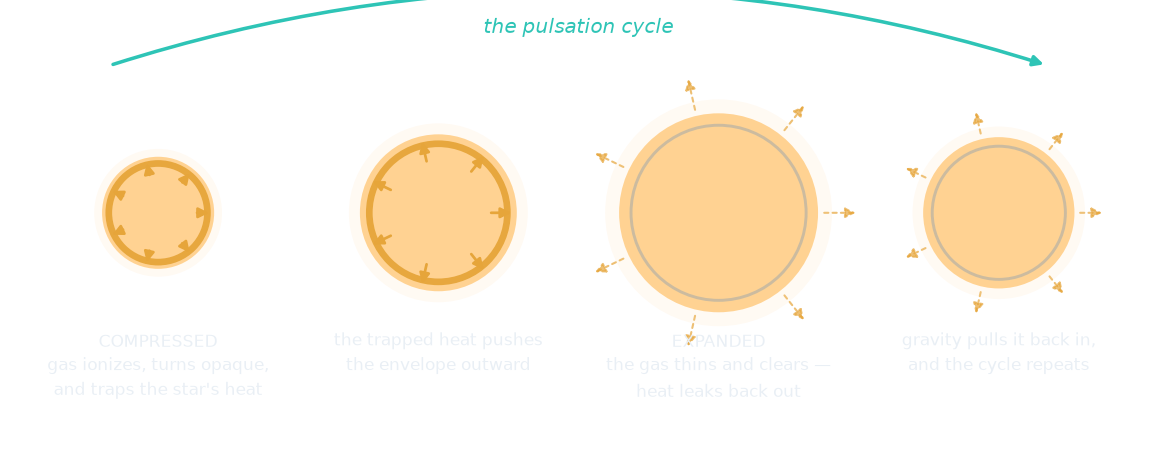
Pulsating stars are heat engines. A layer of ionizing helium deep in the envelope turns opaque when compressed — trapping heat like a closed valve — then clears as it expands, driving the star to swell and shrink (the κ-mechanism). Because a δ Scuti star is small and dense, each breath lasts only hours — and it often rings in several overtones at once.
A real light curve
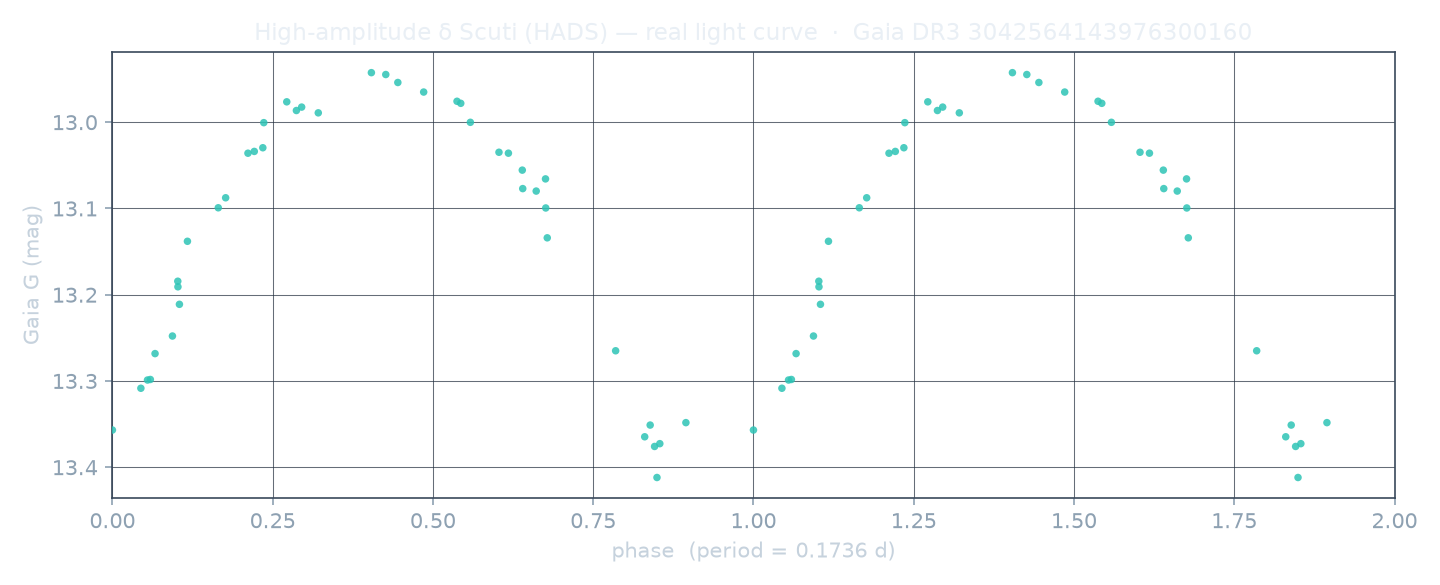
A real high-amplitude δ Scuti (HADS) from Gaia DR3, folded on a period of about four hours (refined from the Gaia epochs). The entire cycle fits inside a single night.
Source: Gaia DR3
In the catalog
VSX lists 747,227 stars as δ Scuti pulsators — many of them flagged ambiguously alongside their γ Doradus and SX Phoenicis cousins, since survey light curves can be hard to tell apart. Of these, 11,430 are the clean, large-amplitude HADS subtype.
Try it yourself
The fast, low-amplitude pulsations demand millimagnitude photometry and a dense cadence — 30–60 second frames for a few hours — but the payoff is resolving oscillations that last only minutes. A good next step once RR Lyrae start to feel easy.
 Variable Zoo