Variable Zoo · The Zoo · Exoplanet transits
EP · transiting planetsThe tiny shadow of a planet crossing its star's face — the same photometry that tracks variable stars catches other worlds.
The animal
An exoplanet transit is the faint, repeating dip in a star's light when an orbiting planet passes directly between us and the star, blocking a tiny fraction of its disk. It is the same idea as an eclipsing binary — but the eclipsing body shines with no light of its own.
The depth of the dip gives the planet's size relative to the star (a Jupiter blocks about 1% of a Sun-like star; an Earth, hundredths of that); the spacing between dips gives the orbital period. Thousands of worlds have been found this way by missions like Kepler and TESS — and the brightest are within reach of a backyard telescope.
A transit light curve has a distinctive flat-bottomed 'U' or trapezoid: the light drops as the planet moves onto the disk, holds low while it crosses, and recovers as it exits. The shape and duration encode the planet's size, the orbit's tilt, and — at the very edges — hints of an atmosphere.
Because a planet blocks so little light, catching a transit demands millimagnitude precision held steady for hours. That is exactly why transit photometry is such a satisfying test of a small telescope and a careful reduction pipeline.
A real light curve
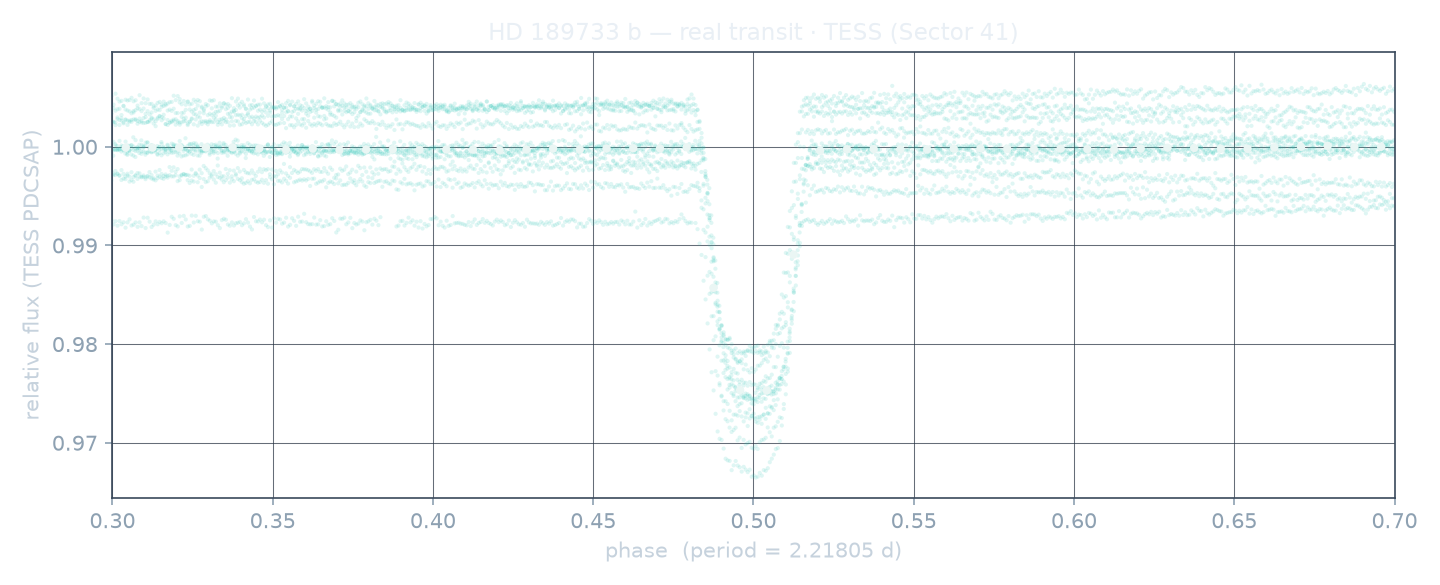
A real transit — the hot Jupiter HD 189733 b, from TESS space photometry, folded on its 2.2-day orbit. The flat-bottomed 2.4% dip is the planet's silhouette crossing the star.
Source: TESS
Try it yourself
Grow or shrink the planet and tilt its orbit, and watch the transit dip respond. The depth of the dip is just the planet's area compared to the star's — try the presets and see how a hot Jupiter makes an obvious dent while an Earth all but vanishes, and how tilting the orbit turns a clean transit into a grazing one, then a complete miss. A simplified teaching model, not a fitting code.
From our survey
In the catalog
VSX flags 1,764 stars as transiting-planet hosts (type EP) — only a slice of the more than 5,000 confirmed exoplanet systems, since VSX catalogs those whose transits register as stellar variability: exactly the signal a small telescope can capture.
Try it yourself
Catching a transit is the most demanding small-telescope photometry there is: you need millimagnitude precision held steady across a multi-hour window bracketing a predicted event. Ensemble differential photometry against nearby stars, and a night with a well-timed transit, put a real planet's shadow within reach — as in our WASP-1 b run.
Go deeper
A short, clear video on how a transit reveals a planet.
The transit method in the context of all the ways we find planets.
A hands-on walk through modelling a real transit light curve.
