Variable Zoo · The Zoo · Mira variables
M · long-period pulsatorsCool red giants near the end of their lives, pulsing so hugely that they swing by many magnitudes over months to years.
The animal
A Mira variable is a dying star: a cool, bloated red giant on the asymptotic giant branch, hundreds of times the Sun's diameter. Its whole outer envelope pulsates in and out over a cycle of months, and as it does the star's visible brightness swings enormously — often by five magnitudes or more.
Miras are the large-amplitude members of the broader family of long-period variables, which also includes the gentler semiregulars and slow irregulars. They are named for Mira (ο Ceti), 'the Wonderful' — the first periodic variable star ever recognised, in 1596.
The pulsation is driven by a valve deep in the envelope: layers of partially ionised hydrogen and helium trap heat when compressed and release it when they expand, pumping the atmosphere like a piston. Because the star is so vast and tenuous, a single cycle takes many months.
Most of a Mira's light shifts in and out of the visible band as cool molecules (like titanium oxide) form and break apart in its atmosphere — which is why the visual amplitude looks so dramatic even though the star's total energy output changes far less.
How it works
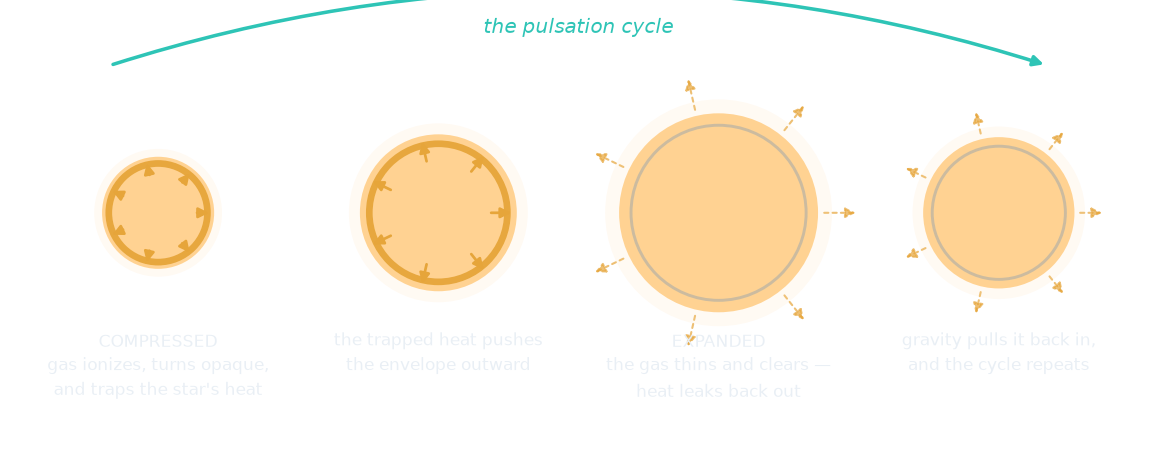
Pulsating stars are heat engines. Deep in the envelope a shell of gas turns opaque when compressed — trapping heat like a closed valve — then clears as it expands and lets the heat escape. That cycle, the κ-mechanism, drives the whole star to swell and shrink. A Mira's envelope is so enormous that a single breath takes months.
A real light curve
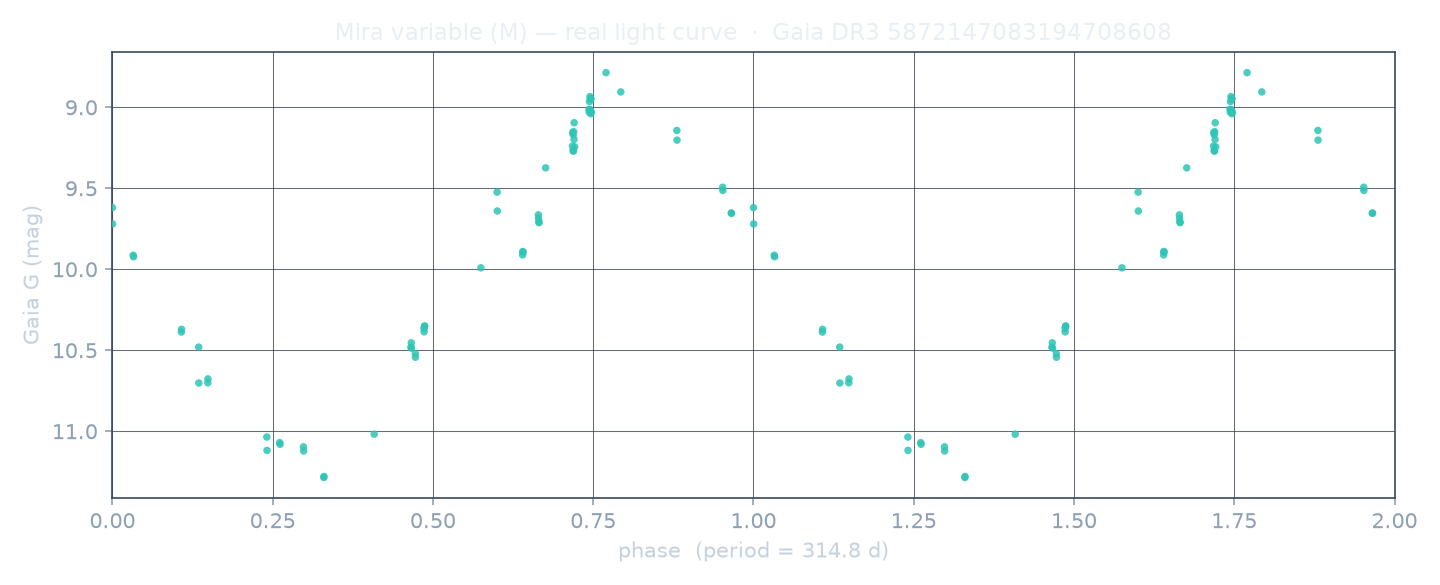
A real Mira from Gaia DR3 epoch photometry, folded on its ~315-day period — swinging close to two magnitudes over nearly a year.
Source: Gaia DR3
In the catalog
VSX catalogs 268,727 Mira variables — the large-amplitude end of a much broader family of pulsating red giants that also includes 644,967 semiregulars (SR) and over 1,618,922 stars logged as slow irregular variables (L).
Try it yourself
Mira stars are the gentlest introduction to variable-star work: amplitudes of many magnitudes mean that a single measurement every week or two, over months, traces the whole light curve. A red-sensitive band works well; the challenge is patience, not precision — which is exactly why they suit a wide-field survey that revisits each field only occasionally.
Go deeper
The story and science of the original variable star.
A closer look at Mira's long-term behaviour from a century of data.
How to monitor Miras and semiregulars and contribute your estimates.
 Variable Zoo