Variable Zoo · The Zoo · Spotted rotators
ROT · starspotsOrdinary-looking stars carrying starspots — dark blemishes that dim them as the star turns.
The animal
Spotted rotators are the most common members of the broad rotating-variables class — stars that change brightness not from pulsation or eclipses, but simply because an uneven surface is turning in and out of view. The cause is starspots: cool, dark patches held in place by strong magnetic fields — the very same physics as sunspots, just far more extensive.
As the star rotates, spots sweep across the visible face and dim it, then rotate away — a gentle, quasi-periodic modulation whose period is simply the rotation period. Single active dwarfs (BY Draconis stars) and tidally-locked active binaries (RS CVn stars) are the classic examples. Not every rotational variable is spotted, though: some are chemically-peculiar stars with patchy surface composition, and others are tidally-distorted 'ellipsoidal' pairs whose changing shape, not spots, does the dimming.
Starspots form where magnetic fields suppress convection, leaving cooler, darker patches. A star usually carries several at once, and because they grow, decay, and drift while the star is not perfectly rigid, the light curve is only quasi-periodic — its shape wanders from cycle to cycle.
The stars we single out here are far more magnetically active than the Sun — often young, rapidly spinning, or spun up by a close companion — so their spots can cover a large fraction of the surface and the brightness swings run from a few percent up to a few tenths of a magnitude, easily caught from the ground (our own Sun, below, is the whisper-quiet extreme).
The same magnetic activity drives flares: sudden brightenings, especially on the coolest, most active dwarfs. Monitor a rotator long enough and you will often catch one.
How it works
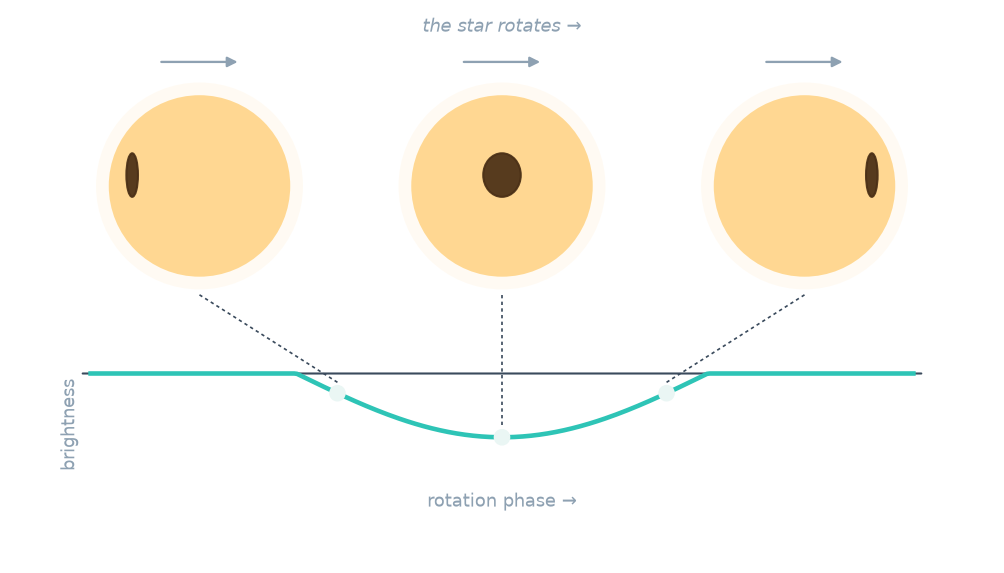
A spotted rotator isn't pulsing or eclipsing — it simply carries starspots (the same physics as sunspots) on a turning surface. As the star rotates a spot swings into view and the star dims, then turns away and it brightens again, so the brightness cycles on the rotation period. (The diagram shows a single spot for clarity; real stars usually have several, which makes the light curve more complex and slowly changing as the spots grow, drift, and fade.)
A real light curve
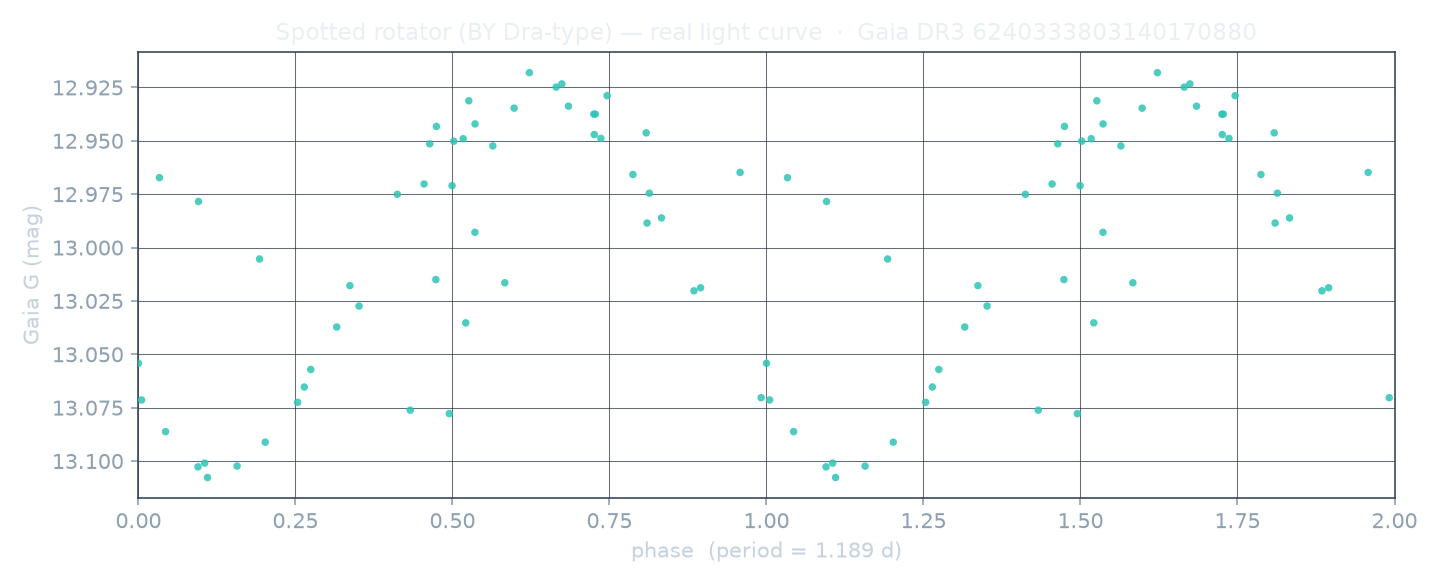
A real spotted rotator from Gaia DR3, folded on its ~1.2-day rotation period. The smooth, slightly wandering wave is dark starspots carried in and out of view as the star turns.
Source: Gaia DR3
Our nearest example
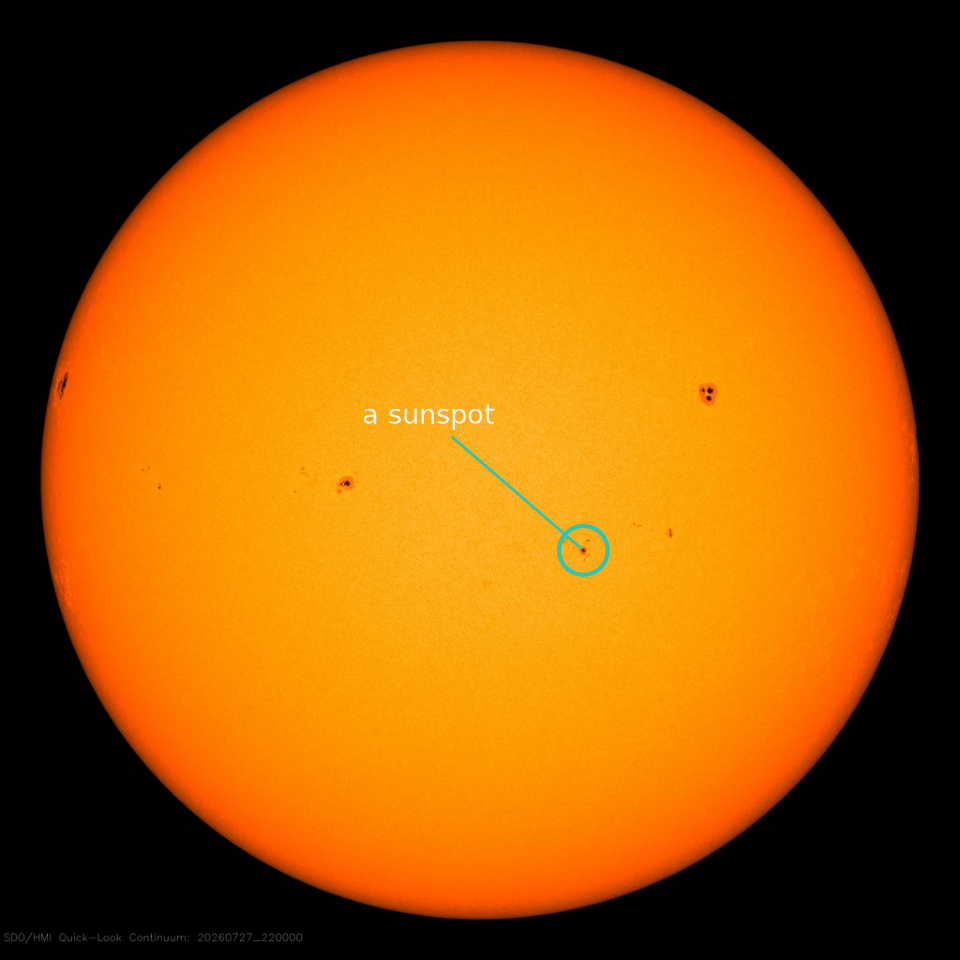
This is a recent white-light image of our own Sun from NASA's Solar Dynamics Observatory, refreshed regularly. Any dark blemish is a sunspot — a cooler magnetic patch, exactly the physics of a starspot (near solar minimum the disk can be blank). Sunspots dim the Sun by only about a tenth of a percent as they rotate across, far too little to flag it as 'variable' — yet in mechanism the Sun is the nearest spotted rotator of all. Come back another day and the Sun's face will have changed.
In the catalog
VSX catalogs 3,265,680 rotational variables — stars whose brightness is modulated as an uneven surface turns, from single active dwarfs (BY Dra, 88,039) to tidally-locked active binaries (RS CVn, 725,565).
Try it yourself
Spotted rotators need only modest precision but plenty of patience: their low-amplitude, quasi-periodic modulation emerges from nights of monitoring, and the period reveals the star's rotation rate. Keep watching the most active dwarfs for the occasional flare.
 Variable Zoo