Variable Zoo · The Zoo · Contact binaries
EW · touching starsTwo stars so close they touch and share one envelope, whirling around each other in a matter of hours.
The animal
A contact binary is a pair of stars orbiting so closely that each has swollen to fill and overflow its Roche lobe — the teardrop of space its own gravity controls — merging into a single common envelope of gas, a cosmic peanut spinning around in well under a day. The prototype is W Ursae Majoris.
Because the two stars share an envelope they share a temperature, so both eclipses are nearly equal in depth and the light varies continuously, with no flat out-of-eclipse phase. Contact binaries are a subtype of eclipsing binary — the most common kind, and among the most abundant variable stars in the whole sky.
The shared envelope keeps both surfaces at almost the same temperature, which is why the two minima look so similar. The light never stops changing: even between eclipses we see the shifting cross-section of two tidally distorted, egg-shaped stars.
Look closely and the two maxima between eclipses are often not equal — the O'Connell effect. The geometry at the two quadratures is mirror-symmetric, so equal maxima are what you'd expect; an inequality betrays an asymmetry on the stellar surface, usually a large starspot (magnetic activity, like an outsized sunspot). Because spots grow, drift, and fade, the asymmetry itself changes over months and years. We measure exactly this effect in our own V0700 Cyg data below — proof that these 'simple' eclipsing systems are anything but boring: they are active, evolving stars.
Over long baselines their periods slowly change as the stars trade mass and angular momentum — and some are expected to eventually spiral together and merge into a single, rapidly rotating star.
How it works
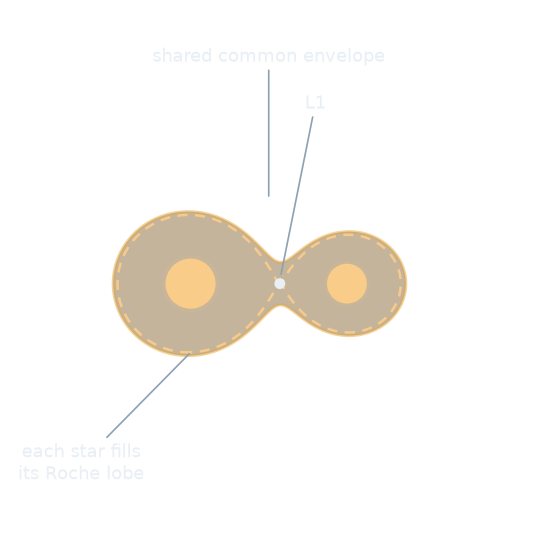
Around each star is its Roche lobe — the teardrop-shaped region in which that star's own gravity wins out. In a contact binary both stars have swollen to fill and overflow their lobes, which meet at the inner balance point L1, so the two merge into a single common envelope (the peanut) wrapping them both. Sharing that envelope holds the pair at nearly the same temperature — which is why the two eclipses per orbit come out almost equal, and the light never stops changing as the egg-shaped stars turn.
A real light curve
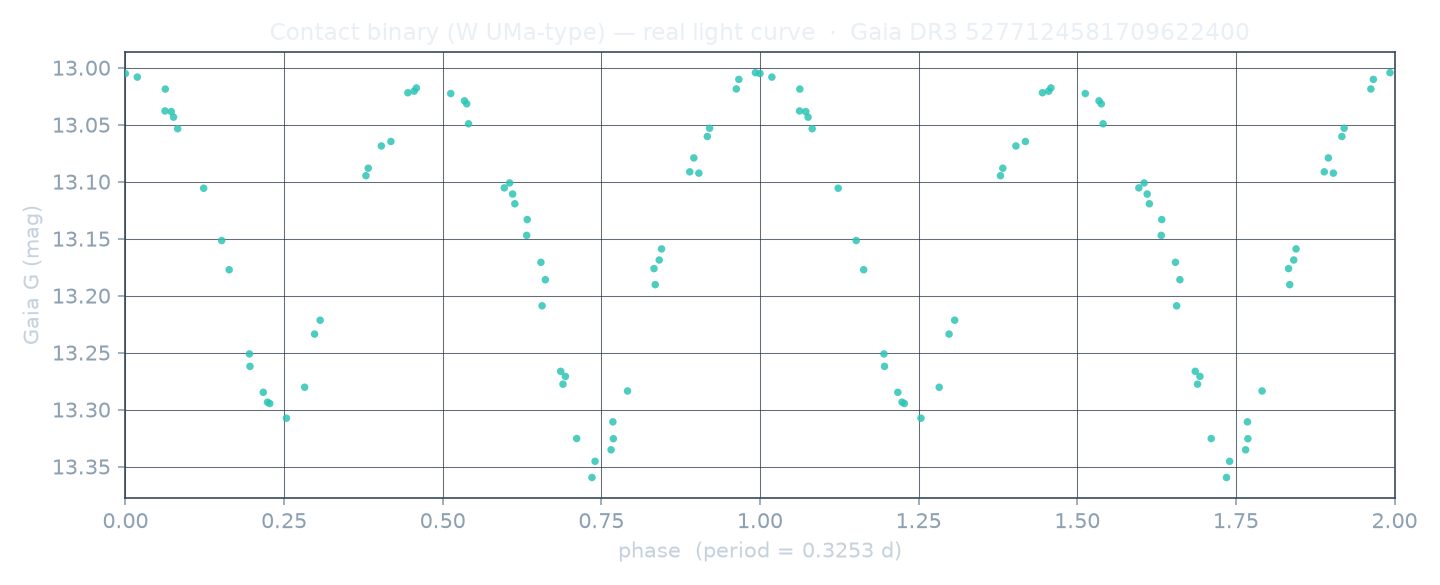
A real W UMa contact binary from Gaia DR3, folded on its ~8-hour orbit. The light never rests: two near-equal minima each cycle, as first one star and then the other is eclipsed.
Source: Gaia DR3
The O'Connell effect
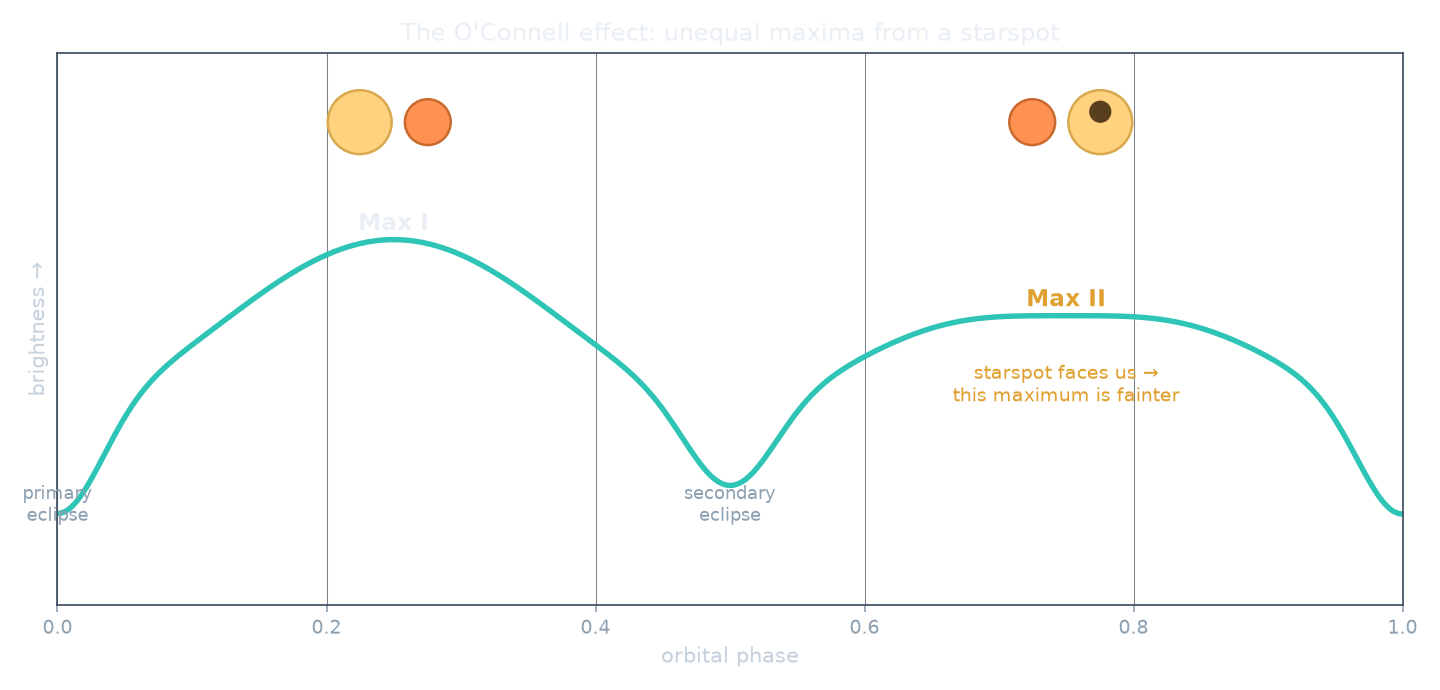
Here is why eclipsing variables are anything but boring. At the two 'shoulders' of the light curve — the quadratures (phases 0.25 and 0.75), where we see the pair side-on — a spotless binary would show two identical maxima. But if a large starspot sits on one hemisphere, then at the phase when that spotted face turns toward us the star is a little dimmer, and one maximum drops below the other. That inequality is the O'Connell effect. Because starspots grow, drift, and fade, the asymmetry changes over months and years — turning a 'simple' eclipsing binary into a probe of stellar magnetic activity. (Schematic — the idea, not real data.)
From our survey
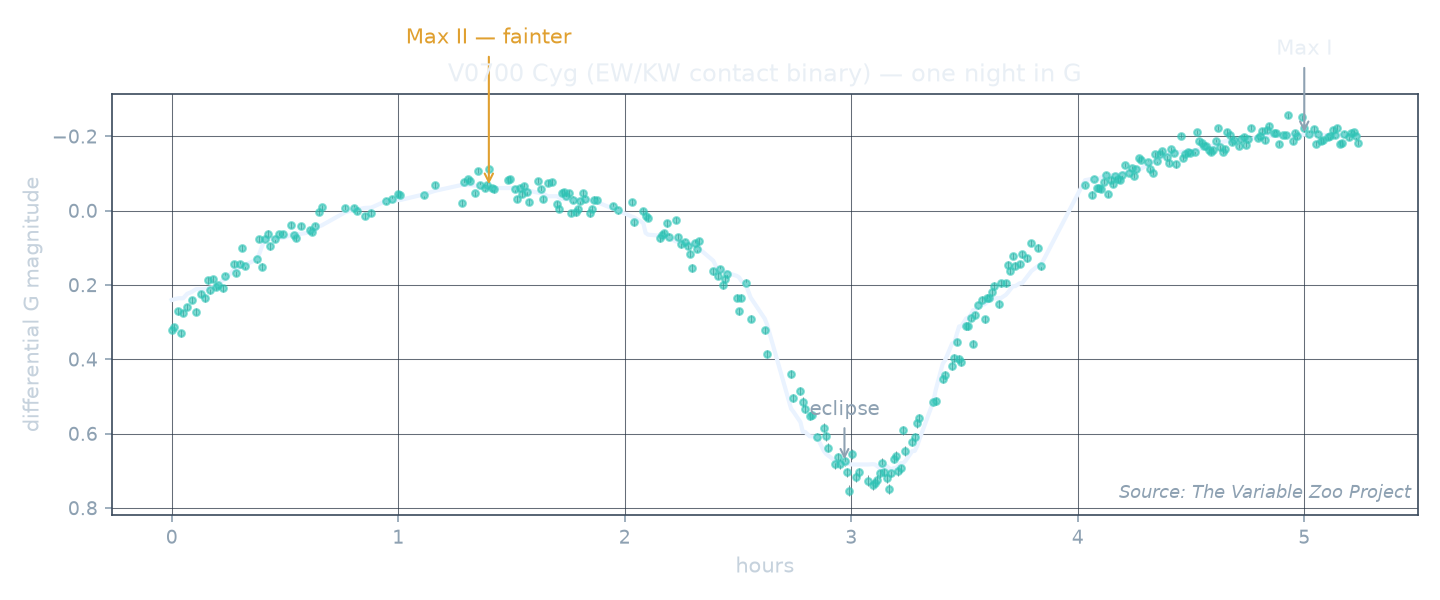
Our own measurement: one night of V0700 Cyg, a W UMa contact binary in the M29 field, in green light. Between the deep eclipse in the middle sit the two quadrature maxima — and the later one (Max I) is clearly brighter than the earlier one (Max II) by about 0.14 mag. In an ideal contact binary they would match; this inequality is the O'Connell effect in real data — the signature of a starspot on one of the two stars.
Source: The Variable Zoo Project
In the catalog
VSX lists 409,742 W UMa-type contact binaries — the single most common kind of eclipsing binary (of 2,639,201 total), and among the most common variable stars of any type.
Try it yourself
Contact binaries are ideal beginner targets: bright, short-period, and continuously varying, so a single night yields a complete, textbook light curve of two near-equal minima. Green frames every few minutes, folded on the sub-day period, do the job.
Go deeper
The prototype contact binary and how its light curve is read.
The EW class — shared envelopes and continuous variation.
Targets and timing for eclipsing systems, contact binaries included.
 Variable Zoo