Variable Zoo · The Zoo · Eclipsing binaries
EA · Algol-typeNot a single changing star at all, but two stars in orbit — taking turns to hide one another.
The animal
An eclipsing binary is not intrinsically variable: it is two stars in orbit, positioned so that from Earth we see the orbit nearly edge-on. Each time one star passes in front of the other it blocks some light, and the system dims.
The prototype is Algol (β Persei), the 'Demon Star,' whose regular winks were explained in 1783 by John Goodricke as an unseen companion. Systems range from well-separated Algol-type (EA) pairs with sharp, distinct eclipses to β Lyrae-type (EB) systems whose ever-changing light betrays their distorted shapes. The closest pairs of all — the contact binaries (EW) — have their own page.
Because the variation is purely geometric, eclipsing binaries are extraordinarily useful: the shape and timing of the eclipses encode the stars' relative sizes, temperatures, and orbit. Two eclipses mark each cycle — a deeper primary (the hotter star hidden) and a shallower secondary.
Track the exact moment of minimum over years and tiny shifts — an O−C diagram — reveal orbital changes, mass transfer, or even unseen third bodies. Eclipse timing is one of the most valuable things a small telescope can contribute.
A real light curve
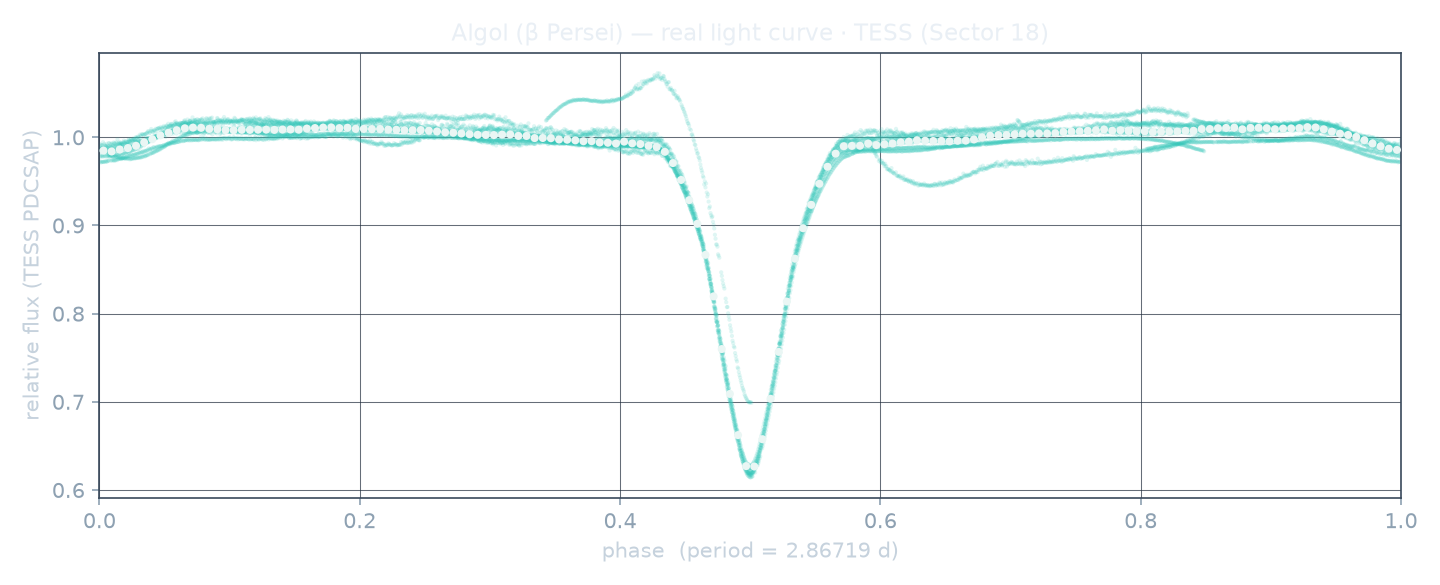
Algol (β Persei) — the 'Demon Star' and the prototype eclipsing binary — from TESS, folded on its 2.87-day orbit. Every 2.9 days the cooler companion slides in front of the hot, bright primary and the system drops by more than a magnitude (the deep primary eclipse); a much shallower dip half a cycle later is the bright star passing in front of the faint one. Algol is in fact a semi-detached triple system — the very complication that makes its eclipse timings so revealing.
Source: TESS
Try it yourself
Drag the sliders — resize each star, change its temperature, and tilt the orbit — and watch the light curve rebuild itself in real time. It's a simplified model, not a fitting code, but it shows the real ideas: the deep primary eclipse, the shallow secondary, and how tilting the orbit takes you from a total eclipse to a grazing one to none at all.
Eclipse timing
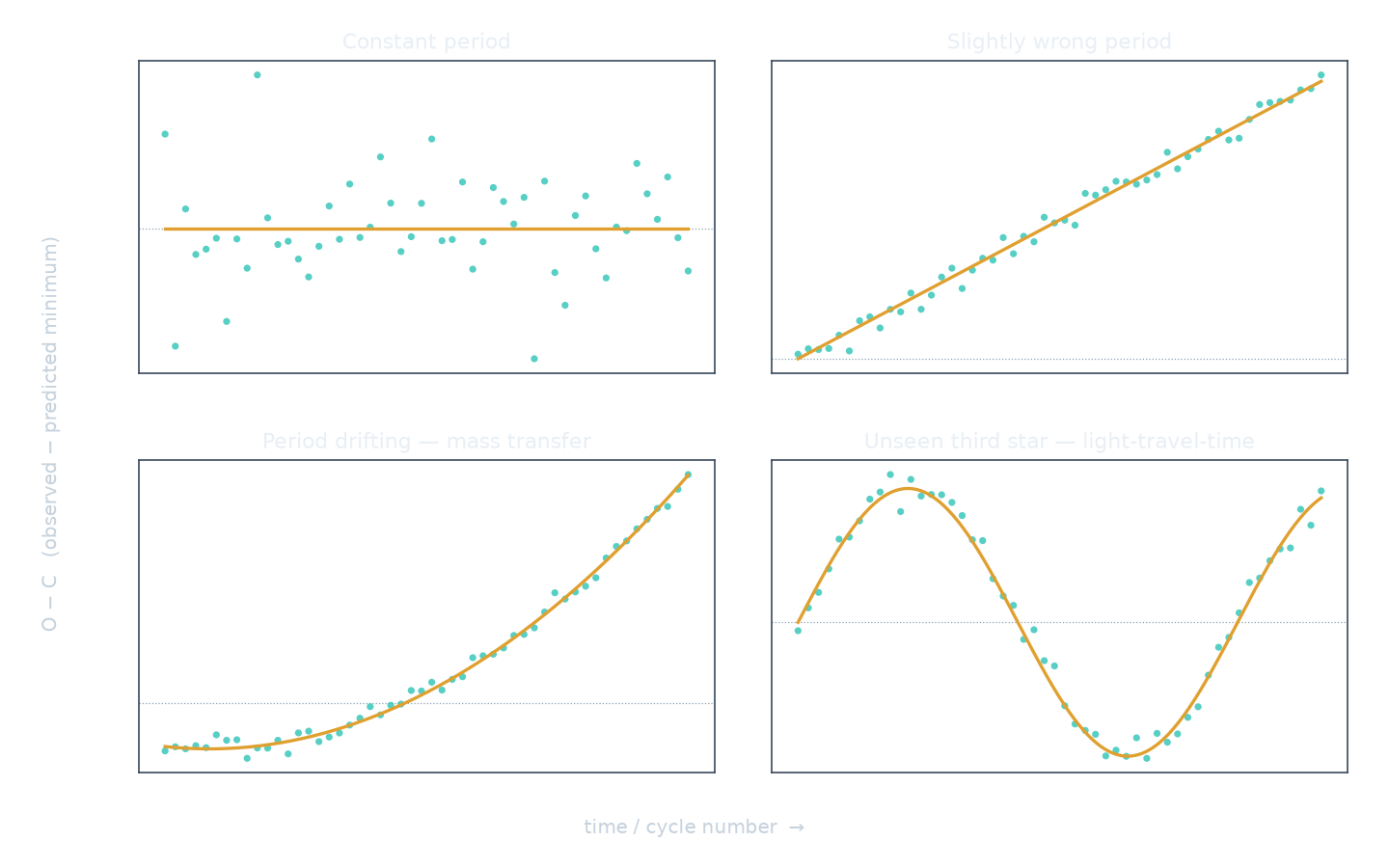
Here is why eclipsing binaries are anything but boring. Time an eclipse minimum, subtract when a constant-period model said it should arrive, and plot that residual — O − C (observed minus calculated) — over years. A flat line means the period is right; a slope means it is slightly off; a parabola betrays a period steadily drifting as the two stars trade mass; a sine wave means an unseen third body is swinging the pair toward and away from us, its light arriving early, then late. Algol itself traces a sine — it hides a third star. These timings are among the most valuable measurements a small telescope can still contribute. (Schematic — the shapes, not real data.)
In the catalog
VSX catalogs 2,639,201 eclipsing binaries — from well-detached Algol systems (EA, 109,374) through β Lyrae types (EB, 33,769) to the contact binaries (EW, 409,742) that get their own page here.
Try it yourself
Eclipsing binaries reward timing over brightness: image through a predicted minimum, measure the moment of deepest eclipse, and contribute an eclipse-timing (O−C) point that helps track the orbit over years. Detached Algols are ideal — flat, steady light punctuated by sharp, deep eclipses you can catch in a single evening.
Go deeper
The original eclipsing binary and how its eclipses were decoded.
The EA class and what eclipse light curves reveal.
Predicted minima, targets, and how to submit eclipse timings.
A full walk-through of eclipse timing and reading O−C diagrams.
The presentation that lays out how to build and interpret an O−C diagram.
 Variable Zoo