Variable Zoo · The Zoo · Variable Star Taxonomy
241 TYPES · 7 CATEGORIESEvery one of the 10,304,607 stars in our catalog is filed under the AAVSO Variable Star Index (VSX) classification — a branching tree of 241 variability types. It looks bewildering at first, but it organizes into just seven big families. Here's the whole tree at a glance, and what unites each family. Or read the history of how we came to watch these stars →
The whole zoo, one diagram
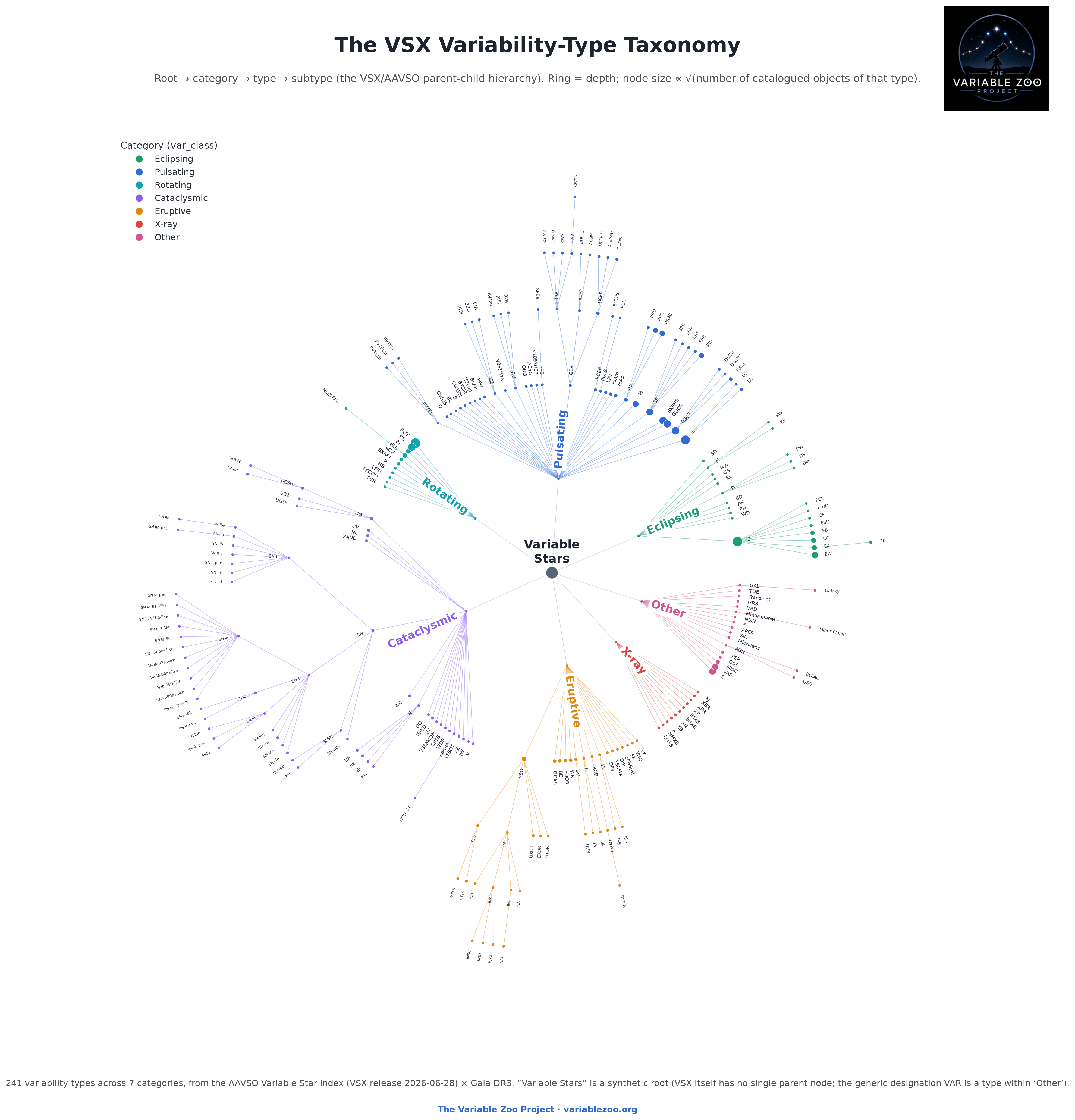
Root → category → type → subtype (the VSX parent–child hierarchy). Node size ∝ √(number of catalogued objects of that type). Open full resolution ↗
Source: The Variable Zoo Project · taxonomy from the AAVSO VSX (release 2026-06-28) × Gaia DR3
Our approach
The tree above is the standard AAVSO VSX classification, under which every star in our catalog is filed. The Variable Zoo Project also maintains its own supplemental, mechanism-based model for identifying and classifying variable stars — reducing the 200-plus legacy types to about a dozen physical mechanisms, recording continua as graded attributes rather than pseudo-types, and keeping every traditional name and type as an alias. Learn more about our approach to variable-star identification and classification →Seven families
Each family is bound by a common reason for varying — geometry, pulsation, rotation, accretion. Counts are live from the catalog; follow the links for the deep dives on individual types.
Not intrinsically variable at all — the light drops when one star (or a planet) passes in front of another along our line of sight. The signature is geometry, not stellar physics: sharp, repeating dips whose shape encodes the orbit and the two bodies' sizes.
Stars that rhythmically swell and shrink, driven by internal 'valves' of opacity and ionization (the κ-mechanism) that trap and release heat. They change size and temperature together — the clockwork of the sky, and for Cepheids and RR Lyrae the period even reveals the luminosity, making them cosmic distance standards.
A patchy, non-uniform surface rotating into and out of view: cool starspots (like giant sunspots), chemical abundance patches, or a tidally distorted companion. The brightness modulation traces the rotation period directly.
Close binaries in which a white dwarf pulls gas from a companion through an accretion disk. Instabilities in that disk trigger dwarf-nova outbursts, and thermonuclear runaways on the white-dwarf surface make classical novae — rare, dramatic brightenings. The exploding-star supernovae live here too.
Irregular brightening and fading from violent activity in or around the star: youthful accretion onto forming stars (T Tauri / YSOs), magnetic flares, ejected shells (Be / γ Cas), and the giant eruptions of luminous blue variables.
Binaries where a neutron star or black hole accretes from a companion and blazes in X-rays; the optical light tracks the accretion. A small, exotic corner of an optical variable-star catalog.
The catch-all: variables not yet studied or classified (S, VAR), plus the genuinely non-stellar objects VSX also indexes — active galactic nuclei, blazars, galaxies, even minor planets.
 Variable Zoo